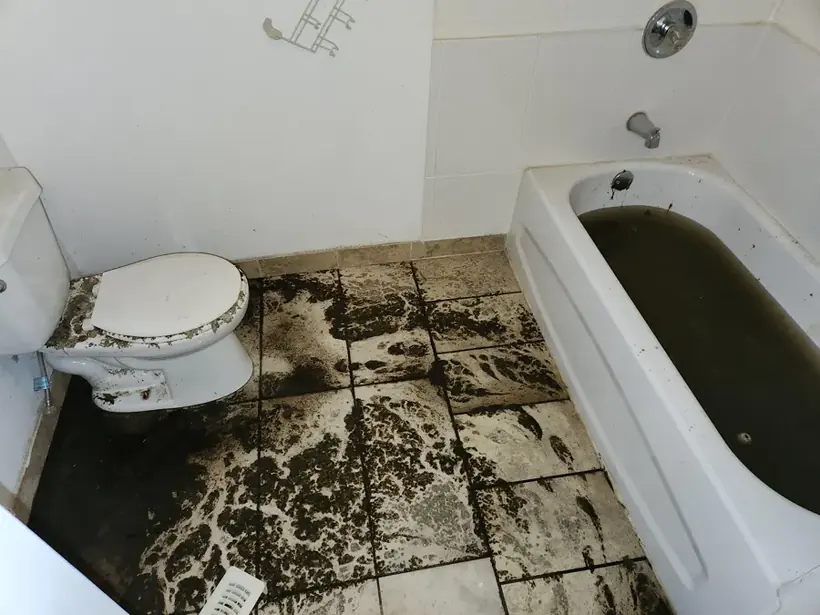
A sanitary backup near Las Tunas Drive, Temple City Park, or Temple Station is not handled like a recent supply leak. People and pets should remain outside the affected area, and plumbing use may need to stop until the source is assessed. The Structural drying service places containment and cleaning ahead of structural drying.
Establish a boundary that protects occupied rooms
Sewage can spread through foot traffic, tools, absorbent contents, and airflow. The response team creates a controlled entrance, identifies handoff areas for bagged debris, and limits movement between dirty and clean spaces. Electrical hazards, slippery floors, and unstable finishes are assessed before removal equipment enters the zone.
- Occupants do not walk through the backup to retrieve routine items.
- Doors and temporary barriers help control the work route.
- Protective equipment is selected for splash, contact, and removal tasks.
- Initial photographs show water edges, residue, fixtures, and affected materials.
- Clean tools and exit procedures prevent the work path from expanding.
Remove contamination from the inside out
Accessible sewage and solids are recovered under controlled conditions. Carpet pad, insulation, wallboard, and other porous materials contacted by sanitary waste are evaluated conservatively because contamination may penetrate beyond a washable face. Debris is contained at the point of removal. Durable surfaces that remain are cleaned before dehumidification and air movement are used for the structural dry-out.
- Loose waste is collected before demolition exposes additional surfaces.
- Porous removal boundaries extend to material that can be cleaned and dried safely.
- Wall cavities are opened where sewage entered around a floor or fixture.
- Hard surfaces receive cleaning across joints, edges, and accessible recesses.
- Air movers stay off dirty residue and loose contaminated debris.
Separate the public sewer fact from the private source
Los Angeles County Public Works performs sewer mainline cleaning, camera assessment, overflow response, containment, and stoppage removal within its maintenance district. At the affected property, the plumber or responsible agency identifies the blocked component and reports the corrective work. The cleanup crew uses that source status to plan safe wastewater removal and prevent renewed contamination.
- The project record states observed fixture behavior and confirmed source information.
- Agency contact or plumbing findings are quoted accurately without assigning ownership.
- Repeated use of affected fixtures is avoided until source control is confirmed.
- Cleanout access and pipe work remain outside the mitigation team's restoration scope.
- Water extraction service supports recovery after the contaminated zone is controlled.
Dry cleaned structure and record the boundary
After contaminated porous material is removed and durable surfaces are cleaned, the remaining framing, concrete, and finishes are mapped for moisture. Dehumidification manages released vapor, while directed airflow reaches safe exposed surfaces without crossing into occupied rooms. Near Roseglen Street, Easton Wash, or Kauffman Avenue, the address does not change this sequence.
- Material readings begin after the surface is prepared for drying.
- Room conditions are recorded inside each controlled work section.
- Equipment changes respond to framing and floor trends.
- Final documentation lists removal, cleaning, drying, and inaccessible locations.
- Reconstruction starts only after retained materials meet the defined dry goal.
Odor alone is not used as a clearance test. The work record instead connects the removed materials, cleaned durable surfaces, controlled work route, and final moisture condition. Any item that cannot be cleaned or inspected is identified for a separate decision. After barriers come down, the exit route and adjacent dry area are checked for tracked residue. That final inspection confirms the containment plan protected spaces outside the original sanitary boundary.