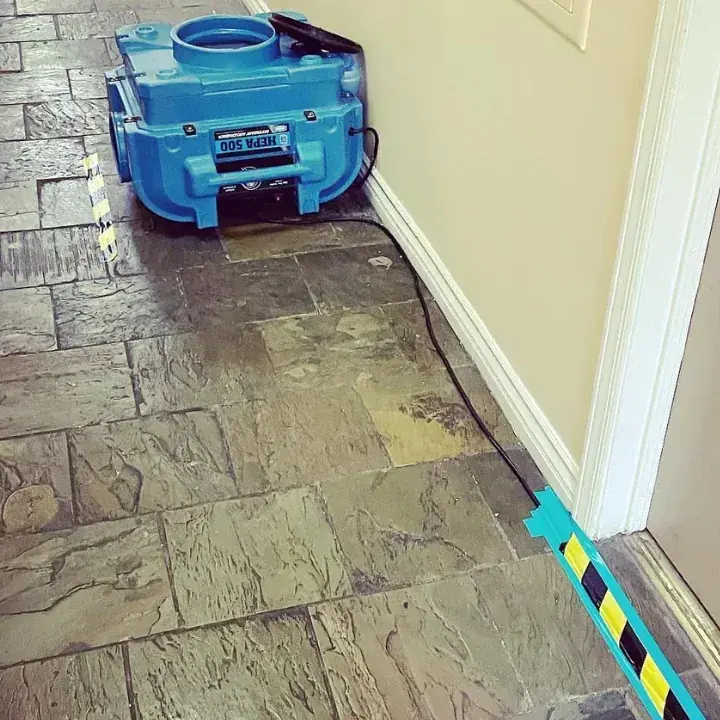
Condensate damage is assessed at the affected building, with attention to the drain, pan, insulation, and wet ceiling assembly. Near the Temescal Valley area, Grand Boulevard, Downtown Corona, or western neighborhoods, a pan overflow can travel through insulation and ceiling seams before appearing below. Local ceiling leak cleanup addresses unstable or wet overhead materials.
Stop new condensate without confusing the two scopes
The cooling professional diagnoses the equipment, pan, drain, pump, or connection and restores safe operation. The mitigation team documents moisture outside that system. Turning off leaking equipment can limit new water, but a cleared drain does not remove water already stored in insulation, wallboard, framing, or floor finishes.
- The equipment status and suspected release point are recorded.
- Wet electrical components remain undisturbed pending evaluation.
- Contents below the stain move after photographs when safe.
- A repair receipt is not treated as drying verification.
- Recurring moisture is reported for renewed source investigation.
Follow the drain route through the building
Condensate can leave the pan, track along a drain, collect at a low ceiling point, or descend inside a wall. The inspection begins at accessible equipment and continues into rooms below and beside it. Measurements extend past the visible mark until comparable dry material is found.
- Ceiling seams are checked beyond discoloration.
- Insulation condition is evaluated where access is available.
- Wall tops and bases can reveal a vertical moisture path.
- Cabinets may conceal water that reached a lower room.
- Flooring receives readings where dripping persisted.
Create access around trapped wet material
A stained ceiling may remain structurally sound, or it may soften and sag. Condition, contamination, and access determine whether board or insulation can remain. Selective openings release trapped moisture and let airflow reach an assembly that a painted surface would otherwise seal.
- Sagging overhead material receives an exclusion area.
- Controlled drainage happens inside a protected work zone.
- Wet insulation is evaluated independently from wallboard.
- Cut boundaries follow readings and physical condition.
- Debris handling avoids unaffected occupied areas.
Monitor after the cooling system is repaired
Air movers are aimed at exposed damp surfaces, while dehumidification collects vapor. The crew repeats measurements at the same ceiling, framing, wall, and floor points. A stalled area may need better access or a revised equipment layout, not simply more operating time.
- Dry comparisons match the type of material tested.
- Humidity records explain the environment around the assembly.
- Daily notes distinguish old retained water from new leakage.
- Local structural drying provides the final measurement sequence.
- Finish repairs follow the documented substrate condition.
the local utility smart meter data relates to water service usage and should not be used to claim that a condensate drain failed. AC water comes from cooling operation, so the loss requires direct equipment findings and indoor moisture measurements. Keeping those systems distinct prevents an unrelated utility signal from entering the project narrative.
Condensate duration can be difficult to determine from one stain. Mineral marks, repeated discoloration, softened board, or an equipment history can support further investigation, but the record should not invent a start time. Material condition and current readings remain the basis for removal and drying decisions. If a repaired drain produces new moisture, the cooling professional should recheck the source while the mitigation team protects the work already completed. That feedback prevents a continuing equipment problem from being mistaken for slow structural drying.
A follow-up reading after normal operation also helps confirm that the repaired drainage route is no longer adding water to the assembly.