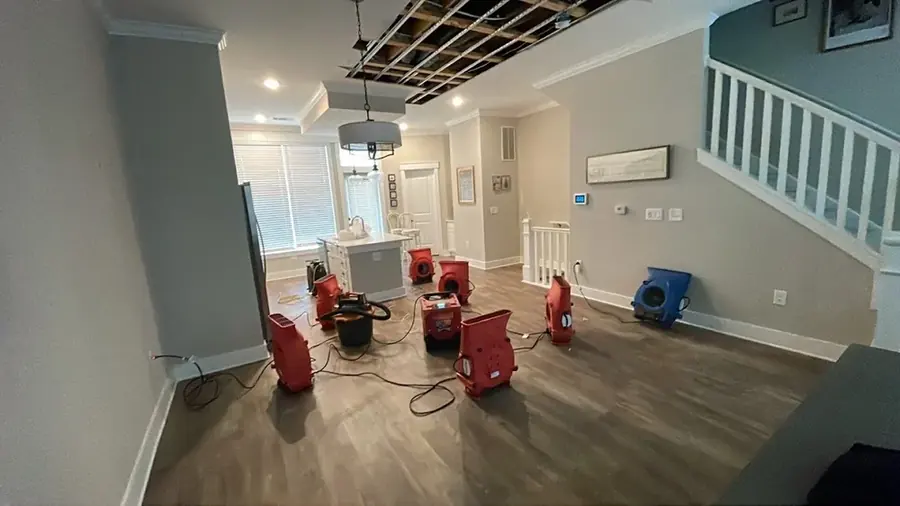
Structural drying in Corona begins after accessible liquid, contamination, and source problems are addressed. A property near Downtown Corona, Grand Boulevard, Corona Regional Medical Center, or the Temescal Valley area can contain several materials with different moisture behavior. No single foundation type is confirmed citywide, so the actual assembly controls the plan. Local extraction prepares wet surfaces for this phase.
Define a dry target for every material
Wallboard cannot be evaluated from a lumber reading, and concrete should not be compared with carpet. The crew identifies affected material classes and chooses similar unaffected areas as references when available. These points turn a vague goal such as looks dry into a repeatable measurement process.
- Room labels remain consistent across every visit.
- Floor, wall, cabinet, and framing points stay separate.
- Instrument type and reading location are documented.
- Reference materials match the assembly being evaluated.
- Inaccessible areas are noted instead of assumed dry.
Remove barriers that stop evaporation
Paint, vinyl, flooring, cabinets, and insulation can limit airflow to the wet layer. Access decisions follow readings, contamination, material condition, and the purpose of an opening. A small base cut may help one wall, while a layered floor may need a different approach. More demolition is not automatically faster drying.
- Surface extraction precedes evaporation whenever practical.
- Closed cavities are checked for insulation and trapped water.
- Finish removal stays tied to the measured boundary.
- Dust and debris controls protect unaffected spaces.
- Exposed materials are cleaned before drying when required.
Balance air movement with dehumidification
Air movers lift moisture from exposed surfaces into the room. Dehumidifiers remove that vapor so the environment continues accepting more. Placement should serve the wet assembly rather than create random airflow. Temperature, humidity, and material trends together show whether the system is productive.
- Airflow aims across damp surfaces without causing hazards.
- Equipment capacity reflects the work-zone volume and moisture load.
- Doors and containment support the intended drying chamber.
- Condensate handling avoids creating a new water problem.
- Electrical distribution is planned for the equipment load.
Change the plan when a reading stalls
Daily monitoring is useful because drying rarely progresses evenly. A wall may reach its reference while an underlayment remains elevated. The team can redirect air, improve access, modify containment, or investigate continuing moisture. Equipment leaves by zone when stable readings support that decision.
- Trend tables show progress at identical measurement points.
- Unchanged readings trigger investigation rather than assumption.
- Dry zones can release while slower materials continue.
- Local water damage services connect the source-specific work.
- Final records identify goals, exceptions, and inaccessible areas.
The community includes residential, medical, educational, manufacturing, and other commercial settings. Those uses change access and continuity needs, but the drying principles remain material-specific. A school room and a home kitchen both need source control, clean surfaces, effective evaporation paths, humidity management, and readings that prove the result.
Equipment removal is another measured decision. A machine may leave when its assigned zone has reached target conditions even if a separate cavity continues drying. Before removal, the crew confirms that reduced capacity will not cause humidity to rebound around remaining wet materials. The next monitoring visit then checks whether the environment stayed stable. This staged approach avoids both unnecessary operation in finished rooms and premature shutdown around a slower floor, wall, cabinet, or framing section.
Equipment and reading labels remain in place during staged removal so the follow-up comparison refers to the same controlled zone.
The final equipment inventory matches each released zone.