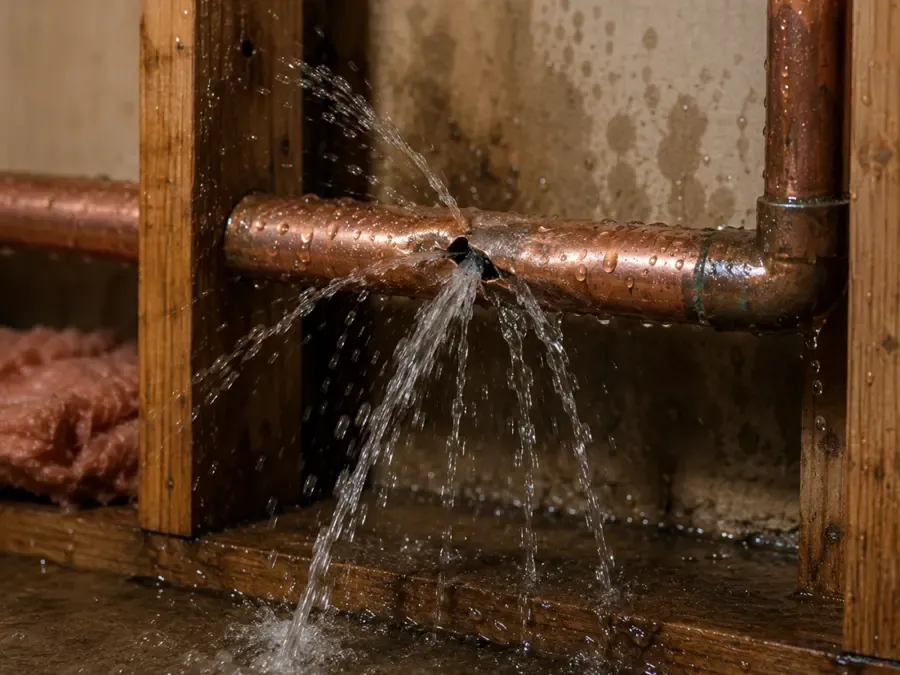
A burst pipe does not respect room boundaries. Water released near Downtown Corona can run inside a partition, beneath flooring, or through a ceiling opening before anyone sees it. Buildings near Grand Boulevard, Corona Regional Medical Center, and western neighborhoods still require their own maps because local geography cannot predict an indoor route. Local extraction service removes accessible water after shutoff.
Make the shutoff safe and specific
The first action is stopping the supply without crossing an electrical hazard or unstable wet ceiling. A fixture valve may isolate a limited failure; a larger break can require the building supply. The plumbing professional handles pipe diagnosis and repair. The mitigation team records the source status and begins documenting water already outside the system.
- Occupants stay away from water touching outlets or equipment.
- Ceiling areas are cleared when board is swollen or sagging.
- The initial report identifies when and how the flow stopped.
- Photographs capture wet rooms before safe contents move.
- Water category is reconsidered when the release contacted contaminants.
Survey vertically as well as across the floor
Pressurized water can spray into insulation and framing, then descend along pipes or wiring. The crew checks the source room, opposite wall faces, neighboring spaces, and every level below. Cool surface patterns are verified with direct moisture readings. This prevents an upper wall break from becoming a ceiling-only cleanup on the lower floor.
- Wall bases are measured on both sides of the source partition.
- Cabinets and closets can hide a narrow downward path.
- Floor penetrations may deliver water to the level below.
- Insulation condition affects whether a cavity needs access.
- Unusual meter readings are compared with dry material nearby.
Remove water before forcing evaporation
Pumping and extraction reduce the amount of moisture that equipment must move as vapor. Carpet, pad, hard flooring, and open framing each require a different approach. After surface recovery, selective removal can expose layers that remain wet or cannot be cleaned. Demolition is tied to condition and access, not simply to the size of the initial spray.
- Extraction passes continue until practical recovery declines.
- Trim can be removed to reach wet wallboard edges.
- Wet porous material is evaluated for cleanliness and integrity.
- Unaffected travel paths stay separated from debris handling.
- Contents receive location labels before relocation.
Dry each assembly against its own reference
Air movers target exposed surfaces, and dehumidifiers collect water released into the work zone. Daily readings return to labeled framing, wall, floor, and cabinet locations. A declining trend supports continued drying. A stalled point prompts a closer inspection for blocked airflow, a missed wet layer, or renewed leakage.
- Equipment moves when the reading pattern supports a change.
- Dry references match the type of material being evaluated.
- Temperature and humidity records explain the drying environment.
- Pipe repair documentation remains separate from mitigation notes.
- Local structural drying carries the project to measured completion.
The local utility provides water service and leak alerts through its smart meter program. Unusual usage prompts a plumbing inspection, followed by a survey of affected rooms when water has escaped. The claim file connects the source finding to photographs and labeled measurements so pipe repair and drying work can be followed separately.
Contents and finish protection should follow the direction of the release. Items directly below a spray need different attention from objects in an adjoining room reached by floor migration. Photographs, room labels, and a simple movement log preserve that distinction. When materials are removed, the record should also note the reason: instability, contamination, physical damage, or access for drying. These explanations turn a list of discarded pieces into a defensible account of how the wet boundary was reduced and prepared for continued mitigation.