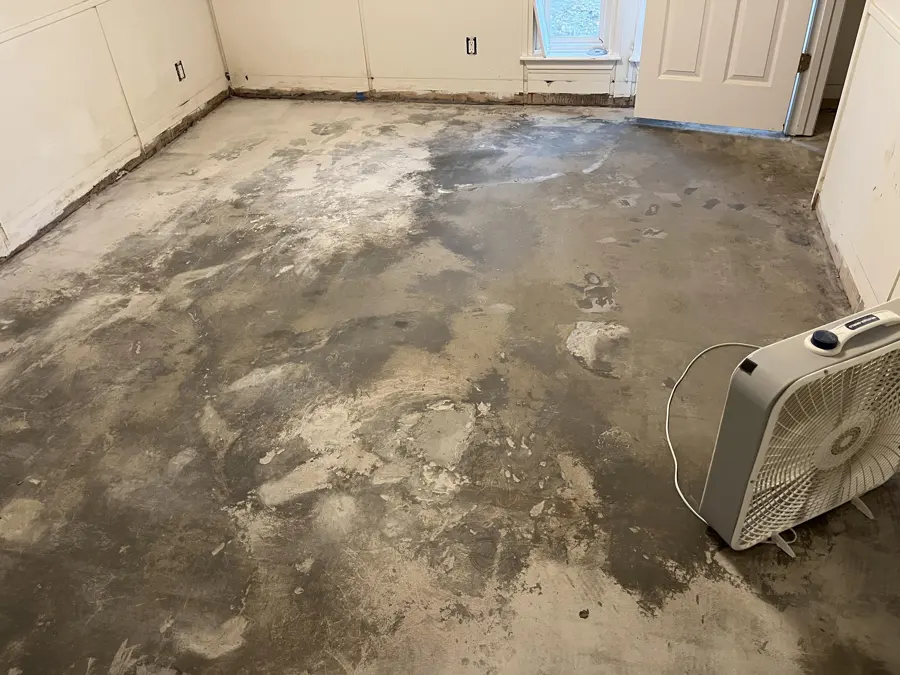
Warm tile, damp baseboards, and lifting flooring need investigation of the supply and the materials below the finish. A plumber tests the suspected leak while the mitigation team maps moisture into adjacent assemblies. From Grand Boulevard to western neighborhoods, Downtown Corona, and the Temescal Valley area, openings are selected from that inspection. Local restoration services address released water after source control.
Keep leak diagnosis separate from moisture mapping
A source test answers whether a pipe is actively leaking. Moisture mapping answers where released water traveled. These are connected but different questions. A completed pipe repair does not remove water beneath a floor, and a high floor reading does not identify the failed pipe. Clear role separation prevents the repair invoice from being mistaken for drying proof.
- The suspected source is isolated before drying progress is judged.
- Wall bases and floor transitions are measured around the clue.
- Cabinet toe kicks receive checks where water could collect.
- Nearby rooms provide comparable unaffected material readings.
- Photographs identify each reading point and visible condition.
Follow the floor system instead of the first stain
Water may migrate beneath tile, floating flooring, carpet, or a built-in before emerging. The survey extends in deliberate intervals until readings return to a suitable dry comparison. Doorways and changes in finish deserve special attention because water can cross the transition while the upper surfaces look different.
- Tile may conceal moisture moving toward adjacent wallboard.
- Underlayment can distribute water beyond a lifted plank.
- Trim swelling may reveal a perimeter path along the room.
- Concrete is observed over time rather than judged by touch.
- Wood products are checked for moisture and dimensional change.
Create access that has a defined purpose
An opening should permit inspection, recovery, cleaning, or evaporation. Removing broad areas without readings can destroy recoverable finishes, while leaving a sealed wet layer blocks progress. The crew starts with the narrowest useful route and expands only when the exposed conditions or new measurements support it.
- Base trim may come off to expose a damp wall edge.
- A small cabinet opening can reach the floor beneath a toe kick.
- Loose finish material is documented before controlled removal.
- Dust and debris controls are set before cutting begins.
- Local structural drying follows the exposed material map.
Prove the substrate is ready for repair
Airflow is directed toward exposed wet surfaces, and dehumidification removes vapor released into the work zone. The team returns to the same floor, wall, and cabinet locations to track the response. If one location stalls, access or equipment placement changes rather than allowing the surrounding dry appearance to control the decision.
- Daily notes link equipment changes to measurement trends.
- Each finish layer is evaluated as a separate material.
- Removed items and dried-in-place materials are listed distinctly.
- Final photographs match the labeled reading locations.
- Floor replacement follows the documented substrate target.
The local utility provides leak alerts through its customer portal. A change in consumption can prompt plumbing tests and checks along floor edges, walls, and cabinet bases. The resulting source report and indoor moisture map show where water escaped, which layers it reached, and what access is needed before the floor can dry.
Finish selection matters during the final handoff. Tile, resilient flooring, wood products, and carpet assemblies each place different limits on when repair can proceed. The mitigation record does not choose the replacement product, but it should state which layer was measured, where access existed, and which areas remained covered. That detail gives the repair contractor a usable substrate history instead of a single room average. It also preserves the difference between a visually acceptable finish and the material below it that controlled the drying decision.